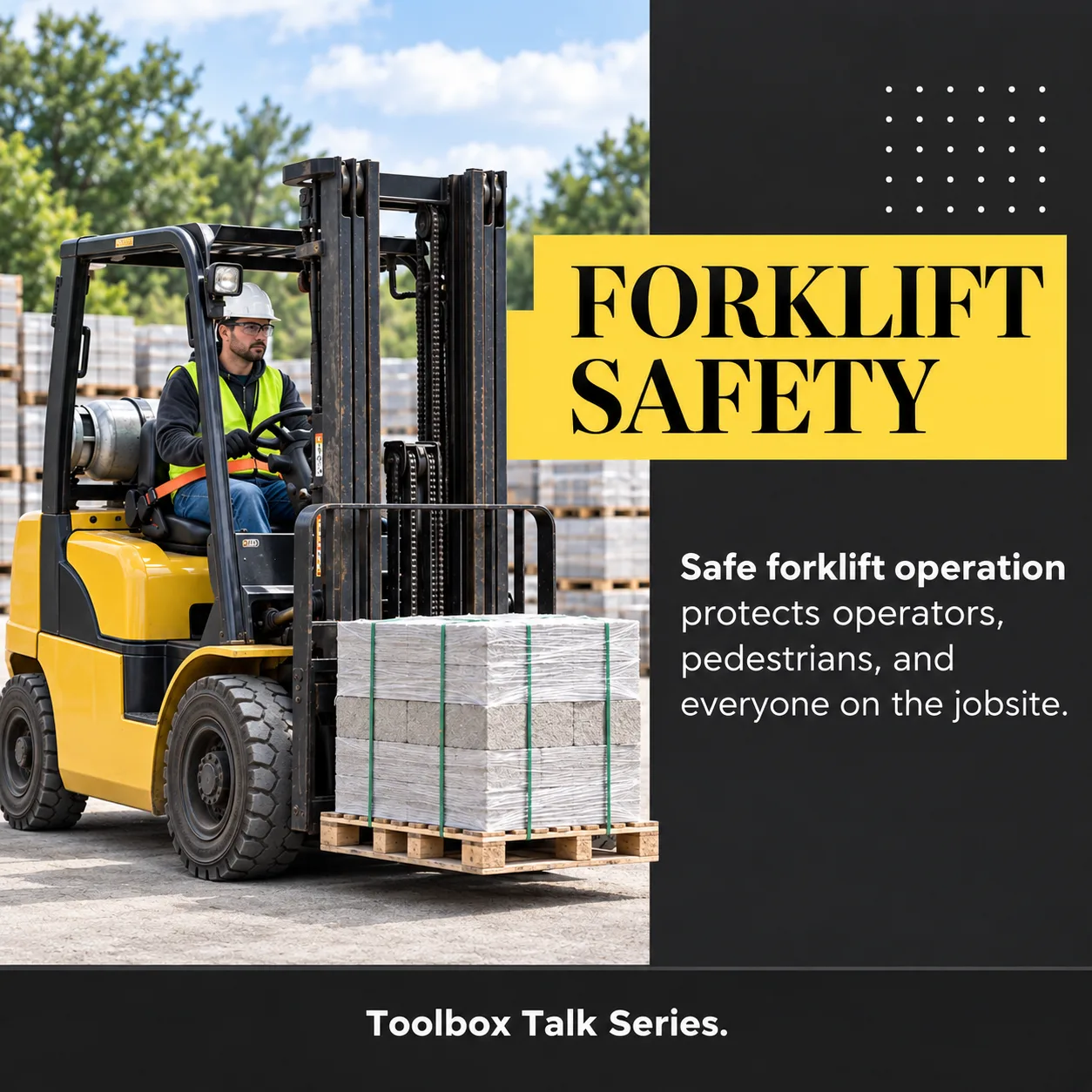
Forklift Safety: Operating and Working Around Powered Industrial Trucks
Know the Equipment. Control the Area. Protect the Crew.
Forklifts and other powered industrial trucks are useful for moving heavy materials, but they can cause severe injuries or fatalities when operated improperly. Common hazards include tip-overs, falling loads, collisions, struck-by incidents, crushing injuries, and falls from elevated forks or pallets.
Only employees who have completed the required training and evaluation may operate a forklift. This toolbox talk provides general safety awareness. It does not authorize an employee to operate a forklift and does not replace equipment-specific instruction, practical training, or an operator evaluation.
Before Operating a Forklift
Before each shift, inspect the forklift according to the manufacturer’s instructions and City Construction Co., Inc.’s procedures. At a minimum, check:
- Forks, mast, carriage, and load backrest
- Tires and wheels
- Steering and brakes
- Horn, lights, alarms, and warning devices
- Seat belt and operator-restraint system
- Hydraulic hoses, cylinders, and visible fluid leaks
- Battery or fuel system
- Data plate, warning labels, and operating controls
- Any attachments installed on the forklift
Do not operate a forklift that is damaged, defective, leaking, or unsafe. Remove it from service, secure it against use, and notify your supervisor immediately. Only authorized personnel may make repairs.
Safe Operating Practices
When operating a forklift:
- Wear the seat belt or operator-restraint system provided by the manufacturer.
- Keep your hands, arms, legs, and other body parts inside the operator compartment.
- Obey posted speed limits and travel at a speed that allows you to stop safely.
- Slow down at intersections, corners, doorways, ramps, uneven surfaces, and congested areas.
- Sound the horn at blind corners, cross aisles, doorways, and other locations where visibility is limited.
- Maintain a clear view in the direction of travel. If the load blocks your forward view, travel in reverse when it is safe to do so, or use a designated spotter.
- Keep a safe distance from pedestrians, other equipment, excavations, loading-dock edges, ramps, and elevated surfaces.
- Never engage in horseplay, racing, stunt driving, or unauthorized use.
- Never allow passengers unless the forklift is designed with an approved passenger seat.
- Never use a phone or other distracting device while operating the forklift.
- Use extra caution on wet, icy, muddy, sloped, or uneven surfaces.
- Follow the manufacturer’s operating instructions and all site-specific traffic rules.
Handling Loads Safely
Before lifting or transporting a load:
- Know the forklift’s rated capacity.
- Check the data plate and account for any attachments that may reduce capacity.
- Never exceed the rated capacity.
- Confirm that the load is stable, centered, balanced, and secure.
- Spread the forks as widely as practical for the load.
- Insert the forks fully beneath the load.
- Tilt the mast carefully to stabilize the load.
- Make sure there is enough overhead clearance for the mast and load.
- Keep the load as low as practical while traveling.
- Never raise or lower a load while the forklift is moving unless the manufacturer permits the operation and conditions are controlled.
- Never permit anyone to stand or pass beneath raised forks or a suspended load.
Do not attempt to move an unstable, damaged, or improperly stacked load. Stop and correct the condition or obtain assistance.
Pedestrian Safety
Forklift operators and pedestrians share responsibility for preventing collisions.
Operators must:
- Watch continuously for pedestrians.
- Yield when a pedestrian enters the travel path.
- Make eye contact and communicate before proceeding.
- Use the horn where visibility is restricted.
- Stop if a pedestrian’s location or intentions are uncertain.
- Never drive toward a person standing in front of a fixed object.
Pedestrians must:
- Use designated walkways whenever available.
- Stay outside forklift operating zones.
- Never walk beneath raised forks or loads.
- Never assume the operator can see them.
- Stop, make eye contact, and receive acknowledgment before crossing a forklift’s path.
- Stay clear of the forklift’s rear swing area.
A forklift steers from the rear, causing the back of the vehicle to swing outward during turns. Standing beside a turning forklift can place a worker between the vehicle and a wall, rack, truck, or other fixed object.
Ramps, Grades, Docks, and Trailers
- Maintain a safe distance from dock and platform edges.
- Verify that dockboards or bridge plates are properly secured and rated for the combined weight of the forklift and load.
- Before entering a truck or trailer, confirm that it is secured against movement.
- Check trailer floors for weakness, damage, holes, or deterioration.
- Confirm adequate overhead clearance before entering enclosed areas.
- Follow the manufacturer’s instructions and site procedures when traveling on grades.
- Do not turn on a ramp or incline unless the equipment and operating procedure specifically permit it.
- Use a spotter when visibility, clearance, or site conditions require one.
Parking the Forklift
When leaving a forklift unattended:
- Park only in an approved location.
- Fully lower the forks or attachment.
- Place the controls in neutral.
- Set the parking brake.
- Turn off the power.
- Remove the key or otherwise prevent unauthorized operation when required.
- Block the wheels when parked on an incline, when required by the equipment or site conditions.
Do not park in an aisle, doorway, emergency exit, fire-equipment access area, pedestrian route, or other location where the forklift could create a hazard.
Tip-Over Response
If a seated counterbalanced forklift begins to tip:
- Stay in the operator compartment.
- Keep the seat belt fastened.
- Hold firmly to the steering wheel or handhold.
- Brace your feet.
- Lean away from the direction of the tip.
- Do not attempt to jump from the forklift.
Jumping can place the operator in the path of the overhead guard or the falling truck. Operators of stand-up or other specialized equipment must follow the manufacturer’s instructions and the emergency procedures covered during their equipment-specific training.
Never Use Forks as a Personnel Platform
Never allow a person to stand, sit, ride, or work directly on raised forks or on a pallet supported by the forks.
Personnel may be elevated only when an approved work platform is used in accordance with the forklift manufacturer’s requirements, applicable regulations, and City Construction Co., Inc.’s procedures. The platform must be properly secured, and all required fall-protection and operating controls must be in place.
Report Unsafe Conditions
Stop work and notify your supervisor immediately if:
- A forklift is damaged or malfunctioning.
- A load is unstable or exceeds the forklift’s capacity.
- Pedestrians cannot be safely separated from forklift traffic.
- A ramp, dockboard, trailer, floor, or travel surface appears unsafe.
- Required alarms, lights, guards, restraints, or other safety devices are missing or defective.
- An operator is untrained, unauthorized, or operating unsafely.
- A forklift collision, near miss, tip-over, falling load, or property-damage incident occurs.
Call 911 for an emergency involving serious injury, fire, hazardous-material release, or an immediate threat to life.
For additional safety information, contact:
Allison Ash, RSO
Email: acash@cityconstructionco.com
Cell: (484) 802-8605
Remember
- Only trained, evaluated, and authorized employees may operate forklifts.
- Inspect the equipment before use.
- Wear the operator-restraint system.
- Control your speed.
- Keep loads stable, within capacity, and low while traveling.
- Maintain clear visibility.
- Watch for pedestrians.
- Never stand or pass beneath elevated forks.
- Remove unsafe equipment from service.
- Stop work when conditions cannot be controlled safely.
Forklift safety depends on training, attention, communication, and disciplined operation. Saving a few seconds is never worth striking a coworker, overturning the forklift, or dropping a load.